Tuesday, October 30, 2012

Hook, Line, and Sinker: A Unit On Electricity

I'm going to try something slightly different in this post. It's the first in a series that I unoriginally call "Hook, Line, and Sinker." The premise, which I literally made up 30 seconds ago is this. I'll show a unit of study by illustrating three parts:
1) The initial "hook, that is what will get kids excited about the unit.
2) The "line", which is, I don't know...  maybe what I want everyone to get out of the lesson. Let's call this the essential questions/enduring understandings portion.
3) Finally I can include a "sinker", which is an extension of the unit that allows students to "go deeper" in their exploration of the subject.

Hmmmm.... I'm sure this has been thought of a million times over before. But not by me! Let's try it and see how it shakes out.

Today I started teaching "Electricity" in science. Here is my hook, line, and sinker for this unit.

The Hook
To be fair, the perfect hook for this unit would be to drive out to my grandparents' farm in rural Kansas, and drop off my students in front of the electrified cow fence with varying sizes and girths of wooden sticks. That's how I first experimented with electricity. And it taught me that so-called insulators like wood and internal organs are actual partial conductors.
 And throwing a stick at this bad boy does not actually demonstrate if it's electric or not.

But in absence of a farm and an instinct that borders on gross negligence, this is the next best hook I have. It's from the Annenburg Learner videos- that great series that looks like it was filmed in the 1950s, yet still has a lot of hidden gems.

The hook is not just the video of course. It's the video and a bulb and a battery and a wire.
In other words, once we watch the video, we try it ourselves. And if we can figure out one way to do it, there are three other ways we can do it! It's an awesome hook, and the kids become instantly curious and frustrated and in love with electricity.


The Line
There are a lot of essential questions for electricity which rises exponentially when we throw magnetism into the mix. But leaving magnetism out for the moment, there are two questions that are sufficient enough to sustain an entire unit: How does electricity flow? and What is a circuit?

The Sinker
After constructing series and parallel circuits with various batteries bulbs and dough, we can do it all over again with various batteries, bulbs, and dough. Squishy circuits expand are definition of what a circuit is and how electricity flows.
Squishy circuits are amazing. Last year I gave one of my students the recipe for the different doughs to see what he could make. He based his science fair project on it. I'll look for the photos I took and add them later.

So how did that work? Should I continue with this series? Let me know.


Monday, October 29, 2012

ISS and Animoto: A Window Into Bad Behavior

One of my mottos that I try to teach by is, "Only use a technology for its intended purpose." Granted, I sometimes fail in this because I get excited about a new web 2.0 application, but as a whole I'm pretty good at following my own advice. With that in mind, I'm trying hard to wrap my brain around the new ISS (International School Services) gimmick to promote its candidates to existing schools.

ISS is a big, clunky umbrella that, among other things, holds job fairs and allows teachers to set up an online portfolio for potential schools to see. Since I registered with them in August, this is what is featured on my ISS Dashboard:
A good 70% of my dashboard is filled with an Animoto promotion. For those of you that can't read mico-text, the plug is this:
Use Animoto to show why you are the perfect candidate for the job you are looking for! Look what one candidate has already done to distinguish herself as a candidate. Her Animoto (see below) is now available at the top of her profile for all the recruiters to see. You too can make the most of this new recruitment technology. It is easy to do – even for non techies - and we have created step by step instructions to show you how. Go towww.animoto.com to create your own slide show and give your candidacy a boost.

My first reaction when I initially saw this in August was...
Except I Wasn't Wearing Garfield Boxers

Why? Because ISS is not following my motto! Here is what Animoto is extremely good at: Creating slideshows. That's it. But there's a reason why I don't go into interviews with a slideshow presentation. Because no potential employer wants to see that. 

How do I know? 
                             I don't. 
                                          I'm just guessing.


But if I was an administrator that needed to do a hunk-of-hirin', I would assume that anyone, no matter how excellent or how poor of a teacher they really are, could throw together a bunch of photos with smiling and studious children.  It tells you absolutely nothing.
For This Photo, I Googled "Children Studying" 

But ISS seems to have fallen into that infamous trap of using a web 2.0 tool just because it exists, regardless of the intended purpose. To support that groundless accusation, I present the subject line of an email they sent me a few days ago:

ISS launches new members' portal featuring cutting-edge technology!

One of the cutting-edge technologies is Animoto, of course (Even though Animoto is a relatively old web 2.0 technology, created around 2006 or 2007, I believe). 

As a counter to this push, I tried last night to make a reasonable counter argument to ISS filling up 70% of my dashboard with an Animoto plug. I decided it would be best if I used Animoto to make my counter-argument. But because I wasn't strictly using Animoto for it's intended purpose, the results are mixed:

The inconvenient truth is that I've might have made this too late. As hip as ISS wants to appear to be, it's Dashboard is ugly and static. In fact it's so static that there doesn't seem to be a way to go back and change any aspect of my profile. Everything I entered (or didn't enter) in August seems to be permanent. So now that I have jumped on the Animoto bandwagon with my own Animoto video that points out why ISS should not be promoting Animoto, there doesn't seem to be a way to update my profile with the new video.
So in a way they're not doing exactly what I'm asking them not to do.


*Update: Did I call ISS clunky and static? What a strange, baseless accusation! And on a totally unrelated note, here is my email correspondance with them while trying to figure out how to update my profile.

  • Editing My Profile

    by Ryan
    Sent:  4:36 AM
    Hi, My name is Ryan and my ID is *******. I would like to make changes on my profile but I can't find where to do that. Please help. Thank you.
  • RE: Editing My Profile

    by Tajuan
    Sent:  12:31 PM
    Dear Mr. Malone, Greetings from ISS. Since your file was already approved you are unable to edit it yourself. If you want to make a change you must let us know exactly what you want changed and we will be happy to assist you. Kind Regards, Tajuan

    So because my profile has been approved, I've been locked out of it. Apparently I might make a change that ISS does not approve of on my profile? I'm not sure if I"m following the only possible logic I can come up with to rationalize this. 


Saturday, October 27, 2012

iPad and Animoto: A Window Into The Classroom

One of the changes I've made this year is using Animoto more frequently to create monthly slideshows of our class photos, and publishing them to our class web page. It's easy to do but adds an extra virtual window into our classroom.
A Window That Apparently Opens Up To An Upside Down Map

It's easy because I am using iPad to take the photos, and rely on "Photo Stream" to synch the photos with my computer. It would be even easier if I liked the Animoto iPad app, but I abandoned it because it doesn't allow me (as far as I can tell) to change the photo speed rate, which I find is critical in making a slideshow.

It's not a big deal though, because "Photo Stream" makes photos taken on my iPad magically appear in iPhoto on my laptop. Then it's just a quick upload and a slow, agonizing decision on the music, and voila! A new slideshow every month:

The August Slideshow
(I should have chosen this style and music for spooky October, but I was fascinated in using extremely intense music to show something that was the opposite)


The September Slideshow


The October Slideshow

Thursday, October 25, 2012

"Material World" & "Where Children Sleep" (Part 2)

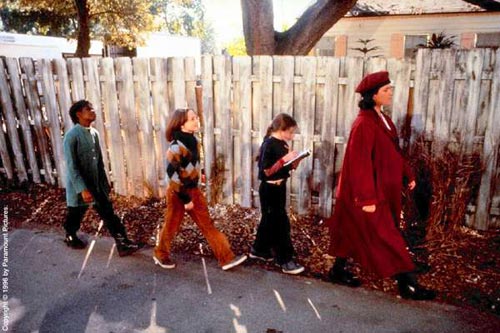
An evolving bulletin board I started this year combines the photo collections of Peter Menzel's Material World and James Mollison's Where Children Sleep. The quote, "There are seven billion people in the world, and each one deserves a closer look," is paraphrased from something Rosie O'Donnell told Michelle Trachtenberg in the movie Harriet The Spy.
A More Subtle Performance Than "Another Stakeout"

I set up the outside bulletin boards at the beginning of the year like this:

After we study "Material World" and "Where Children Sleep", the children combine the two types of photos to create photos of their bedrooms. Then, keeping the same quote the photos are replaced with the children's own work.

 The self-portrait is an art project where the children
1) Draw half of their face, envisioning what they will look like in 15 years, and
2) Draw representations of what they value now, and what they think they will value 15 years in the future.
Their bedroom photos are attached below their self-portraits. My TA had the idea of making a "stand" for the self portraits using the bedroom photos so that the self-portraits could be easily opened and closed, which is why they look like they are curved.


Wednesday, October 24, 2012

"Material World" & "Where Children Sleep" (Part 1)

In the early 1990's Peter Menzel created a photo expose of "average" families in several countries. He asked these families to take out all of the possessions from their house and arrange them with the most important items in the foreground. The result is his remarkable "Material World" and a few of the photos are featured below:


James Mollison recently published a photo book called Where Children Sleep. Once again it takes selective subjects from all over the world and photographs them and their bedrooms. A few of those photos are featured below:


I try to combine both of these projects into part of a values unit that teaches us about ourselves and our classmates. After choosing a Material World poster and studying it, the children create their own "Material World" photo, but instead of hauling everything outside, they arrange it in their bedrooms:

The photo then becomes a piece of a much larger project of tangible values using Fotobabble, which we publish on our individual websites and share with each other. It's also part of an evolving bulletin board, which I'll feature in the next post.


Related Posts Plugin for WordPress, Blogger...